Thursday, April 18, 2024

Class Overview

 The parts of this class that stuck with me the most was Rodriguez's Aria, Hehir's Ablism, and the open forum roleplay for Wind-Wolf. 

Rodriguez's Aria stuck with me because of my service learning experience. I was witnessing students before my eyes "losing out" on instruction because it was taught in English and they only understand Spanish. I watched students get pulled out of class other times during instructional time for what I assume was enrichment...Language barriers are something I never realized the severity of in schools.

Hehir's ableism was interesting to me. I like how it was broken down into different groups. You really don't know what something is like till you hear it from the person it effects. Hehir demasks that. 

The open forum roleplay on Wind-Wolf was interesting. You realized as the others were acting, just how involved/passionate you can get about a situation when it is YOU it effects. 

Wednesday, April 10, 2024

Woke Read Aloud Argument

 A. Hey all, I'll be doing an "argument" analysis from woke read aloud video...the reading wasn't working for me. 

B. To start, boy was that video interesting. I was surprised to see the channel titled woke kindergarten. All things considered, "woke" does not have the best societal connotation...even though it is nothing bad, but to say the least, I'm not surprised the comments were turned off. Smart of the creator.

Personally, I liked the overall message, teaching kids about pronouns, making mistakes, and respecting others. It goes about it in a diverse and informative way. Honestly, I wish kids learned about the concept of pronouns much sooner in life.

Having an understanding from a younger age that just because someone looks like a girl doesn't mean they use she/her is a message I believe kids can handle. I wish I had understood that concept sooo much sooner. It would have helped ten fold in the understanding of my own identity. However, I think learning about what that means in regards to a persons identity should come a little later when they can really grasp that. Fundamentals should be taught younger, and the deeper meanings taught as kids get older and mature...as any topic of this nature should be.

(somebody tell that to the 10,000 year old congressmen)

This is coming from the mouth of a trans guy who grew up in an ultra conservative, catholic household. I don't believe learning what transgender means early on would have been beneficial for me (and that is entirely just my personal experience). I think I would have grown up with a lot of misconceptions surrounding genderfluid identities. However, I don't think that LGBT conversations about identity should be hidden as much as they are. I can honestly and unfortunately say I was extremely intolerant in middle school because of this...and look at me now...pretty much the exact opposite of who I used to be in views AND identity.

It's sad that gender identity has become so polarizing. I worry about my future and the future of others in the community everyday, but unfortunately in the world we live in, there is no "easy" answer when we live in a society so extremely against accepting change. 

C. What do you think could be done to properly start the conversation? 

(Broad I know, but frankly there really is no other way to start this dialogue)

I'm attaching RI's "statement/guide" on transgender and gender non conforming students

RI Guidelines


Thursday, April 4, 2024

Hehir Quotes


A. Hello class, today I'm doing a quotes analysis on Hehir. 

B. The first quote I'd like to put out there is the main one we discussed the meaning of during class...“Disability is not a tragedy, (however) society’s response to disability can have tragic consequences for people who have disabilities.”...I was really glad we discussed this because it could mean so many things. To me, this is remarking on the unfortunate reality on how society views disability as one of two extremes; either something that makes someone completely incapable, or something "fake" that a person uses as an excuse to be difficult/lazy. 

The second quote I'd like to remark on is "disability only becomes a tragedy for me when society fails to provide the things we need to lead our lives — job opportunities or barrier free buildings”. I wanted to remark on this because it is so true. If society listened and adhered to the accommodations and needs of disabled individuals, it could very well be less stigmatized as a tragedy. By normalizing disability, it becomes "less sad/tragic". 

The final quote I'd like to remark on is “Studies of deaf children whose parents are deaf are revealing. These children start school with vocabularies comparable to their hearing peers and have higher levels of educational and occupational success”. I find this important. It really shows and sticks a hand in the idea that disability is not always a disadvantage. Students who are disabled may not be "behind" but rather just need assistance to keep them moving forward.

C. One question I'd like to leave with the class is whether they have experiences surrounding disability and the themes suggested that could shed light into societies need for change? The article I'm including remarks on the overwhelming need of society to work to destigmatize disability. 

Destigmatizing Disability Article


Sunday, March 31, 2024

Aria Rodriguez

 A. Hello everyone, today my analysis will be connections referring to Rodriguez's text Aria. 

B. I find Aria connects very closely with with silenced dialogue and intersectionality. The troubles Rodriguez faced in regards to his forced education on the English language (and subsequent 'loss' of Spanish) give a hand to a topic that has only recently been genuinely recognized. ELL education still to this day, even in my service learning placement is not at all where it should be. The fact that some teachers still have to resort to google translate and/or have students lose hours of lessons due to a communication gap is not only unfair to students, but also teachers. It's a topic not talked about enough, and even though it is talked about more today, that does not mean it is discussed sufficiently and effectively. In regards to intersectionality, it is not students faults when they hit this crossroads between language and proper education. It should be up to the schools systems to accommodate the needs of students who do not know they dominant language, no matter in the US or in a different nation. Unfortunately the US is one of the nations with ELL education being such a prominent problem. This ties into my connections and further analysis below. 

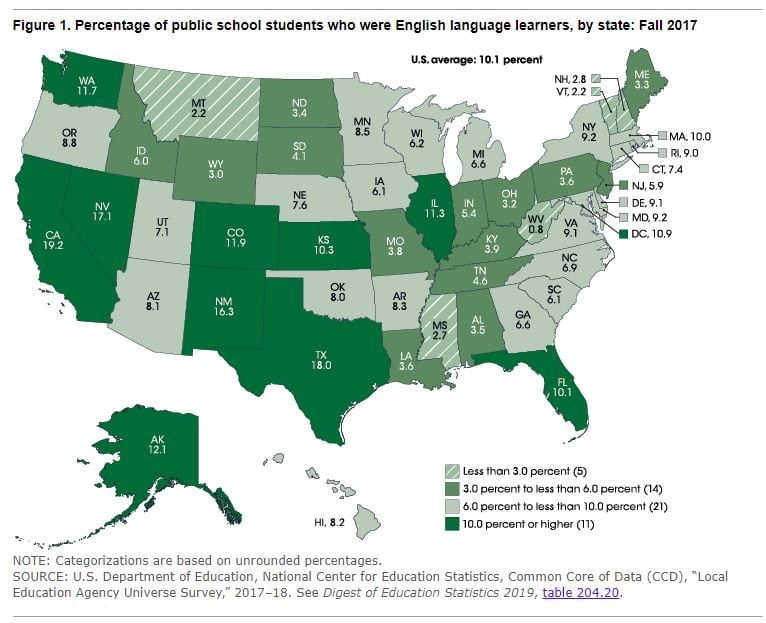
C. One question I would like to leave with the class is, have any of you seen struggles with ELL accommodations whether during FNED 101 observations or with your service learning placements this semester? The article I am introducing includes some statistics on ELL students across the United States. I would have never known before looking at this that Rhode Island has one of the highest ELL percentages across the country. 

ELL Statistics

Unfortunately I can't figure out how to include the most recent graphic from the article, so I'm adding an older version. 


Friday, March 1, 2024

Finn Reflection

 Hey everyone,

A. This week I will be doing a reflection on Finn's "Literacy with an Attitude" and how it relates to my school experiences. 

B. While reading (in depth) Chapter 2 of Finn's writing, he discusses the study performed by Anyon regarding the difference between different class based schools in different school districts. The most intriguing part was hearing the break down of what Anyon experienced in the various different 5 grade classrooms and how they differed. Hearing all the different details from the various schools made me realize and pinpoint where my schools fell in the realm of Anyon's experiences. Obviously this study does not mean every middle class school will be the same for instance, but I would have thought my schools would have fit into one category. When reading I noticed that my schools fell into multiple different categories. Obviously, I imagine the schools in the study could have experiences not written about that fall into other categories, but I just found it interesting. Lincoln has a wide array of economic classes within its borders, so I assume it would make sense that our schools would exhibit characteristics from the various backgrounds that were discussed. I just think it is interesting for the prospect that one district can also fall into the working class, through the elite category, sometimes at the same time. 

C. Some questions I would like to leave to the class is, what school that Anyon experienced do you feel that you related to the most? Did your district vary through multiple classes as I feel mine did? What did you relate to most in the article? For my article, I am going to attach a link to a fact sheet regarding the relationship between economic class and education and its affects on the students.

Fact Sheet


Sunday, February 25, 2024

Tatum Hyperlinks

Hey everyone...

A. My reading was by Tatum and is an excerpt from their book called "Why are all the black kids sitting together in the cafeteria".

B. When I was reading this excerpt, I was immediately drawn to the concept of political socialization. I had not thought about it since taking AP US Government and Politics my senior year. It is a process where people gain their beliefs, values, and attitudes towards government from others, starting at a young age. This kind of process is what Tatum discusses, just with race/differences. I found this fascinating as I had not realized before that political socialization could be so similar to other "socialization" processes in the world today. I'm including a hyperlink regarding political socialization incase anyone would like to see the comparison.{ Political Socialization }. I believe that knowing the similarities and just how common socialization is in our society can help people become more aware of their impacts on others, especially young impressionable kids who learn political ideology from their parents (without their parents even realizing sometimes.) This connects to Precious Knowledge in that, if people were only more educated on these matters would they see the importance of diversity and how exciting different cultures can be. 

C. The point I'd like to leave with the class is that, in my opinion, people need to think through their words and who their speaking to, and especially, around, before discussing serious social justice issues. People don't realize just how impressionable younger generations are and their need to come to their own in beliefs, attitudes, and ideologies. Socialization is important to lay a ground work for younger gens, but a groundwork is not "an entire building". Younger gens need to get the full picture from the get-go so they can come to their own without fanning ignorance due to lack of proper education on seriously important matters of social justice initiatives in today's world. 


Crenshaw Connections

 Hello everyone, I'll be doing my response on connections to the Crenshaw video.

A. The Ted Talk was given by Kimberly Crenshaw on the subject of intersectionality. 

B. This talk heavily connected to the concept of silenced dialogue from previous readings. It explained the court case of a women named Emma who experienced intersectionality, but wasn't even allowed to properly speak on the matter to the court, never mind have any shot at justice. She had experienced discrimination at both the racism and sexism spheres, but went overlooked because her case fell into the "cross roads". It is sad to think that someone could be silenced so easily without even getting to hear the full case because it would give her an "extra shot" that everyone else does not have. A concept that is so very backhanded might I add. I think this video also connects to culturally responsive pedagogy in the sense that, we need to be better educated on matters occurring within different groups in order to help advocate and spread the stories of (for instance) the black women who had been unjustly killed in the video. If we properly educate on the differences between individuals from the point of the classroom, then we can effectively start creating a more tolerant society for the future to slowly but surely (we hope) eliminate the issue.

C. One point I'd like to throw out there is the sad fact that I did not know any of the names. I know this video is older so I may have heard the names back when the stories had first come out, but the fact I couldn't remember any is just sad and a testament to the truth of the video. Here is a link regarding the background and mission of the Say Her Name movement. 

Say Her Name


Friday, February 16, 2024

Kohn/Video Quotes

  A. Hey guys, I'll be doing a Quotes Analysis on Kohn's "What to Expect in a Classroom", and I’ll tie it into the Culturally Responsive Pedagogy video at the end.

B. Firstly, I'd like to just point out, boy does this chart put things into perspective on just how dull my high school was. I don't think I ever had a class with all categories in the "Good Signs" column, I'm gonna be honest. 

The first quote I want to mention is under the "Possible reasons to worry" section and its "Chairs all facing forward (even worse) desks all in rows". This really surprised me. 99% of my high school classes were either all students facing forward or students completely in rows. I never really thought about how detrimental/negative that arrangement could be until I saw it in the "bad" column of the chart. We really don't realize how having our seats in a group can help morale even if it is just the teacher talking. Rows with students all facing front now just feels so institutionalized. Some of my classes in college are like this too, I won't be able to look at it the same way.

The next quote I want to mention is also under the "bad" column, and that's on the location of the teacher being "front and center". I never realized how this could be a detriment to the classroom either. Having teachers floating around and helping kids honestly feels so rare to me having been in AP/Honors classes in high school. Honestly I couldn't tell you when a teacher spent at least 50% of the time milling around with students, never mind a majority of the time. 

The final quote I would like to mention is also from the same column, and it's on stuff in the classroom being "Textbooks, worksheets and other instructional materials predominate; sense of enforced orderliness' '. This is one thing I would like to refute, at least in my opinion as a student. A majority of my teachers had a lot of reference materials like this around their room. Although some did balance it out with decorations I was still appreciative of those with such materials as it made it easier to get help and extra practice. Granted the room may have looked a touch more dull, but the teachers normally would make up for it in other ways. Decorated classrooms are tough subjects because you have to find the line between too plain and too chaotic. 

Classrooms exhibiting these traits from the negative column lack the ability to appropriately utilize culturally responsive pedagogy, as discussed in the video. We really don’t realize all that we are missing when it comes to such stagnant classrooms. As the video stated, there is no such thing as “one size fits all” classrooms with how diverse people can be. Having classrooms following the negative column of Kohn, makes it so they cannot properly connect with the cultures of their students. 

C. One question I would like to ask is, can anyone confidently say they have had a class that fits the entire "good signs" column? If so please share because that is SO rare. I'm including an article on the benefits of decorating a classroom. 

https://www.learningandthebrain.com/blog/getting-the-principles-just-right-classroom-decoration/


Thursday, February 8, 2024

Kozol - Extended Comments

A. Hey all! I'm doing extended comments on Jack's blog for Kozol...

B. Overall, I like the points that were made. In your first paragraph you mention the unaffordability of basic necessities, of which you are right. It's crazy to think of basic needs like heat and water. People really take for granted being able to y'know, wash your hands/flush your toilet/take a hot shower. I can't imagine what it would be like to live like that. Then you also mentioned the close proximity. It's really scary, my house is pretty small so I think living with my parents and my dog is a lot but I really can't imagine. 

After, you mention how the author learned directly from members of the community, I started thinking about how only if people were more well educated on matters such as those happening in this community. A lot of the topics brought up in this class really amount to needing to educate the ignorant in order to at MINIMUM have a basic understanding of the issues going on in neighborhoods not far out of our reach. Crime rates are a whole other issue. I like references works by Bryan Stevenson when talking about inequality in the justice system. I liked your last paragraph and personal statement as well. Like I said, it all amounts to ensuring people actual educate themselves on issues in order to actual start helping to alleviate the problems. 

C. One point I'd like to share is just that I find it so sad that we cannot live in a world where people take at least 2 minutes to sit and learn about world issues. It's a rough cycle of ignorance is what it is. The article I'm including is on the effects of concentrated poverty in certain schools. I think it's important to look at the issues posed in all of these articles from an education perspective. Concentrated Poverty


Friday, February 2, 2024

Reflection on Delpit/Lake

 Hello! I'm doing a reflection this week...

A) The reflection this week is on "An Indian Father's Plea" by Robert Lake and Delpit's "The Silenced Dialogue"

B) Both of these readings really made me think about the current education system in my hometown. Throughout school I was always considered one of the "smart kids" (how completely stupid by the way, I basically would never get extra help in class because "oh his grades are good he's fine" but like I hate math and not getting some extra support made me almost fail my sophomore year but I digress...) so I never really truly saw the backhandedness of the education system from my own eyes. Rather, I saw it through my peers and family, most specifically my cousin. This mostly relates to "An Indian Father's Plea". In that article, Wind-Wolf was being subject to unfair treatment and sent into a special education class. His parents obviously knew he didn't belong there and didn't need it so they fought for him so he wouldn't be separated/"over helped". My cousin was subject to the issue of being "under helped". He is on the autism spectrum, and struggled to focus in class and get work done. He wasn't a great test taker either (but neither was I to be fair). He is able to read/write/and speak, and thus was put into general educated classes aside a majority of the student population. A lot of the classes he had to take were pushing on his range of comprehension/outside of his specific interests. My uncle/his father fought every year for the 12+ years he was in the school system to get extra help, and outside support, but he never really got as much help as he needed. He greatly would have benefitted from having an extra support system in his classes; an assistant teacher who would work 1 on 1 with him for instance. He needed that 1 on 1 support but basically never got it because, at least in my opinion, the school thought he was "good enough" to focus their resources elsewhere. I don't know how the school gets to determine when a kid is "good enough" when he clearly is struggling; his father was advocating for him for a reason, but that's beyond me. When he would advocate to his teachers on his own, they weren't very helpful either (which is a whole other issue on silenced dialogue, but I'm already writing too much). During covid, he worked side by side with my grandmother in order to actually get the work done while virtual and start to improve his grades. She was such a blessing because he got that one on one support from her, and the turn around was crazy. He even gained some more skills in his work ethic for when we eventually went back in person because someone sat down with him to learn those skills. Only when he had one of those assistants/ 1 on 1 workers in his actual classrooms was he actually heard/helped enough to better his grades while in-person and in the end, managed to graduate on time with me. But, this story really just goes to show how upside down and backwards some systems are in terms of distribution of resources and help to students who actually need it. 

C) In terms of my question to pose to the class: I wonder what can be done to fix this hierarchical nonsense to actually fix schools systems to make the students the priority not just in word/mantra but in active change?

Here is an article regarding 1:1 aides and their work with autistic students. 

How 1:1 Aides Can Support/Hinder Autistic Students


Friday, January 26, 2024

Argument Regarding Johnson

   Hey y'all; I'll be arguing about Johnson's point in the article...

    A. The author of the article was Alan Johnson. The title was "Privilege, Power, and Difference..." 

    B. The author Johnson argues that society has minimized the extent of damage caused by privilege, power, and differences through sugar coated language and sheer lack of willingness to make a change by majority groups. Johnson's most significant points come when he includes anecdotes about himself regarding power, bias, etc. He explains how he himself is privileged in the very beginning of the article, as he is white and male, establishing clear background for the reader before diving into his interpretation of our current society. He talks about his experience of speaking on oppression while being unable to use vital language such as oppression, power, racism, sexism, etc... and how that made it difficult to get his points across. Not being able to use the proper language when talking about these issues leads to the feeling of individuals speaking to a brick wall; hence why minority groups and those effected by oppression make such little progress on their own. By including these little story bites, the reader doesn't just hear a blanket rant, they can see the points he is making in an actual, real-life context. His main point in all of this is seemingly to show just how complacent society has become in these issues. 

    C. A point/question I'd like to pose is "What situations have you all gone through, that can shed some more light on the complacency of society in discussions on oppression?" Obviously this would only be for those comfortable with sharing, but I think it would be beneficial to hear stories from other students in classroom not only to connect with the article, but connect with each other.
Here's an article regarding complacency in oppression discussions. It connects to SCWAAMP in that it discusses specifically a "feminist" view of these conversations targeting societies "preference to maleness: 
https://everydayfeminism.com/2015/01/complacent-ally-pitfalls/
(Incase the hyperlink doesn't work)

Sunday, January 21, 2024

Introductions

Hello!

I'm Rey! I'm a secondary education history major, who is also hoping to pick up a minor in public history (museums, archives, historic houses and all that jazz). Over break I mostly hung out with my boyfriend.

We took this a day or two before he went back to college

I also worked...as one does. I'm a teacher assistant at a daycare, and I'm also a tour guide on campus.

A craft we made for Thanksgiving
A photo from me at open house

When I'm not in class/a favorite hobby of mine is theater! I was in the run crew for Bat Boy which happened at RIC in November, and I will actually be playing the character Lennox in Macbeth at the end of February!
A photo of me while backstage at Bat Boy!

That's all from me! I can't wait to get to know the rest of you...

Class Overview

 The parts of this class that stuck with me the most was Rodriguez's Aria, Hehir's Ablism, and the open forum roleplay for Wind-Wolf...